翻訳ページ
このページは AI の支援を受けて英語から翻訳されています。内容が異なる場合は英語版が正となります。
AWS グローバルインベントリ
このガイドでは、StackQL を使用して、特定の AWS アカウント内の すべてのリージョン にある すべてのサービス の すべてのリソース について、包括的なインベントリを生成する方法を示します。StackQL は、SQL 構文を使用してクラウドインフラストラクチャとリソースのクエリとデプロイを行える強力な開発ツールです。
動作確認済み 組み込み SQL バックエンド postgres SQL バックエンド macos linux powershell
仕組み
StackQL は、複数のクエリを非同期に処理できる SQL エンジンを実装しています。たとえば、次のようなクエリです。
SELECT region, COUNT(*) as num_functions
FROM aws.lambda.functions
WHERE region IN (
	'us-east-1','us-east-2','us-west-1','us-west-2',
	'ap-south-1','ap-northeast-3','ap-northeast-2',
	'ap-southeast-1','ap-southeast-2','ap-northeast-1',
	'ca-central-1','eu-central-1','eu-west-1',
	'eu-west-2','eu-west-3','eu-north-1','sa-east-1')
GROUP BY region;
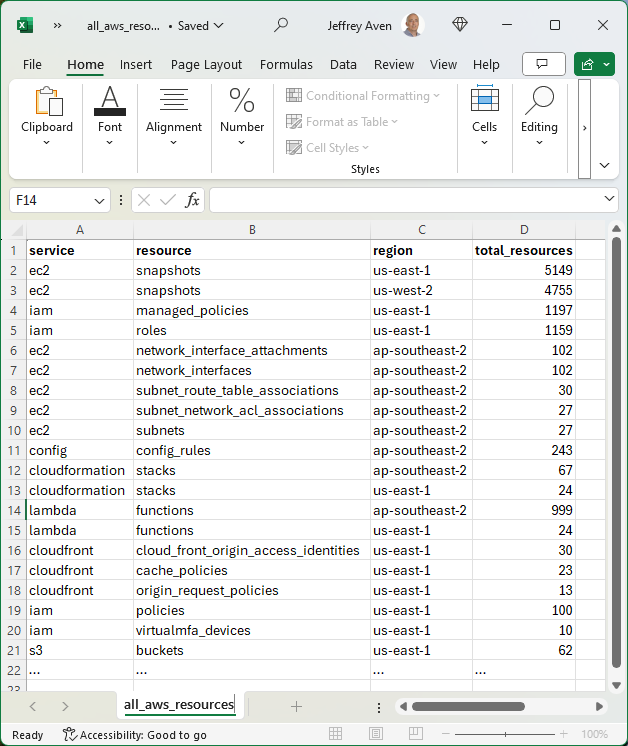
上記のクエリは、実際には並列に実行される 17 個のクエリ(リージョンごとに 1 つのクエリ)であり、その結果が集約されてレポートとして表示されます。StackQL の Python ラッパーである pystackql を使用すると、該当するサービスがサポートする すべてのリージョン について、すべてのサービス の すべてのリソース を反復処理できます。その結果、次の例のように、各リージョンに各リソースのインスタンスがいくつデプロイされているかを示すレポートが得られます。
前提条件
pip install pystackqlでインストールできるpystackqlReadOnlyAccessポリシー以上がアタッチされた AWS ユーザーまたはロール(ロールはsts assume-roleで引き受け可能)AWS_ACCESS_KEY_IDおよびAWS_SECRET_ACCESS_KEY環境変数の設定(AWS Cloud Shell を使用すると自動的に設定可能)
コード
次のコードは、以下の処理を実行します。
- すべての AWS リージョンのリスト(
regions)と、サービスごとにサポートされるリージョンのリスト(supported_regions)を定義する(supported_regionsの導出方法の詳細は AWS Service Support by Region at a Glance を参照) awsおよびawsStackQL プロバイダーがまだインストールされていない場合は、それらをプルする。- 各サービスを反復処理し(
SHOW SERVICESを使用)、サービスごとに各リソースを反復処理する(SHOW RESOURCESを使用) - すべてのリージョンにわたる各リソースのすべてのインスタンスを非同期に
SELECTし、データをリージョンごとにグループ化して、リージョンごとに各リソースのインスタンス数をカウントする
コードは次のとおりです。
- stackql-aws-inventory.py
- resources.py
- regions.py
from regions import supported_regions, regions
from resources import excluded_resources, resource_filters
import time
from pystackql import StackQL
import pandas as pd

stackql = StackQL(output='pandas', page_limit=-1, execution_concurrency_limit=-1)

def pull_stackql_providers():
    providers_df = stackql.execute("SHOW PROVIDERS")
    installed = providers_df['name'].values if not providers_df.empty else []
    for provider in ('aws', 'awscc'):
        if provider not in installed:
            print(f"{provider} not installed. Installing {provider}")
            res = stackql.executeStmt(f"REGISTRY PULL {provider}")
            print(res['message'])

def get_s3_buckets():
    # special case for s3 buckets - use the awscc provider's list view, which
    # returns each bucket alongside its region in a single query across all regions
    regions_in = ", ".join([f"'{region}'" for region in regions])
    buckets_df = stackql.execute(f"""
        SELECT region, bucket_name
        FROM awscc.s3.buckets_list_only
        WHERE region IN ({regions_in});
    """)
    # Group by region and count the total resources (buckets) in each region
    grouped = buckets_df.groupby('region').size().reset_index(name='total_resources')
    grouped['svc'] = 's3'
    grouped['res'] = 'buckets'
    output_df = grouped[['svc', 'res', 'region', 'total_resources']]
    return output_df

def main():
    start_time = time.time()
    pull_stackql_providers()
    results_df = pd.DataFrame(columns=['svc', 'res', 'region', 'total_resources'])
    # get all enumerable aws services
    services_df = stackql.execute("SHOW SERVICES IN aws")
    for svcIx, svcRow in services_df.iterrows():
        service = svcRow['name']
        if service in supported_regions:
            # check all enumerable aws resources in the service against supported regions
            resources_df = stackql.execute(f"SHOW RESOURCES IN aws.{service}")
            plural_resources = [resource for resource in resources_df['name'].tolist() if resource.endswith('s')]
            if plural_resources:
                for resource in plural_resources:
                    print(f"Checking {resource} in {service}...")
                    if service == 's3' and resource == 'buckets':
                        print(f"Checking location for s3 buckets...")
                        resource_df = get_s3_buckets()
                    else:
                        # should we skip this service?
                        if service in excluded_resources and resource in excluded_resources[service]:
                            continue
                        # check if the resource is global or regional
                        if 'global' in supported_regions[service]:
                            regions_in = ", ".join([f"'{region}'" for region in regions])
                        else:
                            regions_in = ", ".join([f"'{region}'" for region in supported_regions[service]])

                        # check if there are additional where clauses for this resource
                        where_clause = resource_filters.get(service, {}).get(resource, '')

                        resource_df = stackql.execute(f"""
                            SELECT '{service}' as svc, '{resource}' as res, region, COUNT(*) as total_resources
                            FROM aws.{service}.{resource}
                            WHERE region IN ({regions_in}){where_clause}
                            GROUP BY svc, res, region
                        """)

                    if not resource_df.empty:
                        # Append resource_df to the results_df
                        if not 'error' in resource_df.columns:
                            results_df = pd.concat([results_df, resource_df], ignore_index=True)
    end_time = time.time()
    elapsed_time = end_time - start_time
    print(f"Elapsed time: {elapsed_time:.2f} seconds")
    results_df.to_csv('all_aws_resources.csv', index=False)

if __name__ == "__main__":
    main()
# exclude these resources
excluded_resources = {
    'cloudformation': ['public_type_versions'],
	'gamelift': ['locations'],
    'codepipeline': ['custom_action_types'],
    'ssm': ['patch_baselines'],
	'iot': ['domain_configurations'],
	'ce': ['anomaly_monitors', 'anomaly_subscriptions'],
}

# apply an additional filter to these resources, to filter defaults or AWS managed resources
resource_filters = {
    "appconfig": {
        "extensions": " AND SPLIT_PART(id, '.', 1) <> 'AWS'",
    },
    "apprunner": {
        "observability_configurations": " AND SPLIT_PART(observability_configuration_arn, '/', 2) <> 'DefaultConfiguration'",
        "auto_scaling_configurations": " AND SPLIT_PART(auto_scaling_configuration_arn, '/', 2) <> 'DefaultConfiguration'",
    },
    "athena": {
        "work_groups": " AND name <> 'primary'",
        "data_catalogs": " AND name <> 'AwsDataCatalog'",
    },
    "cassandra": {
        "keyspaces": " AND keyspace_name <> 'system_multiregion_info'",
    },
    "codedeploy": {
        "deployment_configs": " AND SPLIT_PART(deployment_config_name, '.', 1) <> 'CodeDeployDefault'",
    },
    "ec2": {
        "snapshots": " AND ownerAlias <> 'amazon'",
    },
    "elasticache": {
        "users": " AND user_id <> 'default'",
    },
    "events": {
        "event_buses": " AND name <> 'default'",
    },
    "iam": {
        "managed_policies": " AND SPLIT_PART(policy_arn, '/', 1) <> 'arn:aws:iam::aws:policy'",
        "policies": " AND SPLIT_PART(Arn, '/', 1) <> 'arn:aws:iam::aws:policy'",
    },
    "kms": {
        "aliases": " AND SPLIT_PART(alias_name, '/', 2) <> 'aws'",
    },
    "memorydb": {
        "acls": " AND acl_name <> 'open-access'",
        "users": " AND user_name <> 'default'",
        "parameter_groups": " AND SPLIT_PART(parameter_group_name, '.', 1) <> 'default'",
    },
	"ram": {
		"permissions": " AND SPLIT_PART(arn, '/', 1) <> 'arn:aws:ram::aws:permission'",
    },
    "route53resolver" : {
        "resolver_rule_associations": " AND SPLIT_PART(resolver_rule_association_id, '-', 2) <> 'autodefined'",
        "resolver_rules": " AND SPLIT_PART(resolver_rule_id, '-', 2) <> 'autodefined'",
    },
    "scheduler": {
        "schedule_groups": " AND name <> 'default'",
    },
    "ssm": {
        "documents": " AND SUBSTRING(name, 1, 3) <> 'AWS' AND SUBSTRING(name, 1, 6) <> 'Amazon' AND SUBSTRING(name, 1, 3) <> 'Aws' AND name NOT IN ('AlertLogic-MDR', 'CrowdStrike-FalconSensorDeploy', 'DynatraceOneAgent', 'FalconSensor-Linux', 'FalconSensor-Windows', 'New-Relic-infrastructure-monitoring-agent', 'TrendMicro-CloudOne-WorkloadSecurity')",
    },
}
# all AWS regions
regions = ['us-east-1', 'us-east-2', 'us-west-1', 'us-west-2', 'ap-south-1', 'ap-northeast-3', 'ap-northeast-2', 'ap-southeast-1', 'ap-southeast-2', 'ap-northeast-1', 'ca-central-1', 'eu-central-1', 'eu-west-1', 'eu-west-2', 'eu-west-3', 'eu-north-1', 'sa-east-1']

# regions supported by services
supported_regions = {
 'accessanalyzer': ['global'],
 'acmpca': ['global'],
 'amplify': ['us-east-1', 'us-east-2', 'us-west-1', 'us-west-2', 'ap-south-1',
             'ap-northeast-2', 'ap-southeast-1', 'ap-southeast-2',
             'ap-northeast-1', 'ca-central-1', 'eu-central-1', 'eu-west-1',
             'eu-west-2', 'eu-west-3', 'eu-north-1', 'sa-east-1'],
 'apigateway': ['us-east-1', 'us-east-2', 'us-west-1', 'us-west-2',
                'ap-south-1', 'ap-northeast-2', 'ap-southeast-1',
                'ap-southeast-2', 'ap-northeast-1', 'ca-central-1',
                'eu-central-1', 'eu-west-1', 'eu-west-2', 'eu-west-3',
                'eu-north-1', 'sa-east-1'],
 'apigatewayv2': ['global'],
 'appconfig': ['global'],
 'appflow': ['us-east-1', 'us-east-2', 'us-west-1', 'us-west-2', 'ap-south-1',
             'ap-northeast-2', 'ap-southeast-1', 'ap-southeast-2',
             'ap-northeast-1', 'ca-central-1', 'eu-central-1', 'eu-west-1',
             'eu-west-2', 'eu-west-3', 'sa-east-1'],
 'applicationinsights': ['global'],
 'apprunner': ['us-east-1', 'us-east-2', 'us-west-2', 'ap-south-1',
               'ap-southeast-1', 'ap-southeast-2', 'ap-northeast-1',
               'eu-central-1', 'eu-west-1', 'eu-west-2', 'eu-west-3'],
 'appstream': ['us-east-1', 'us-east-2', 'us-west-2', 'ap-south-1',
               'ap-northeast-2', 'ap-southeast-1', 'ap-southeast-2',
               'ap-northeast-1', 'ca-central-1', 'eu-central-1', 'eu-west-1',
               'eu-west-2', 'sa-east-1'],
 'appsync': ['global'],
 'aps': ['us-east-1', 'us-east-2', 'us-west-2', 'ap-south-1', 'ap-northeast-2',
         'ap-southeast-1', 'ap-southeast-2', 'ap-northeast-1', 'eu-central-1',
         'eu-west-1', 'eu-west-2', 'eu-west-3', 'eu-north-1', 'sa-east-1'],
 'arczonalshift': ['global'],
 'athena': ['us-east-1', 'us-east-2', 'us-west-2', 'ap-southeast-1',
            'ap-southeast-2', 'ap-northeast-1', 'eu-west-1', 'eu-north-1'],
 'autoscaling': ['global'],
 'backup': ['global'],
 'backupgateway': ['global'],
 'batch': ['global'],
 'budgets': ['us-east-1', 'us-east-2', 'us-west-1', 'us-west-2', 'ap-south-1',
             'ap-northeast-2', 'ap-southeast-1', 'ap-southeast-2',
             'ap-northeast-1', 'ca-central-1', 'eu-central-1', 'eu-west-1',
             'eu-west-2', 'eu-west-3', 'sa-east-1'],
 'cassandra': ['us-east-1', 'us-east-2', 'us-west-1', 'us-west-2', 'ap-south-1',
               'ap-northeast-2', 'ap-southeast-1', 'ap-southeast-2',
               'ap-northeast-1', 'ca-central-1', 'eu-central-1', 'eu-west-1',
               'eu-west-2', 'eu-west-3', 'eu-north-1', 'sa-east-1'],
 'ce': ['global'],
 'chatbot': ['global'],
 'cleanrooms': ['us-east-1', 'us-east-2', 'us-west-2', 'ap-northeast-2',
                'ap-southeast-1', 'ap-southeast-2', 'ap-northeast-1',
                'eu-central-1', 'eu-west-1', 'eu-west-2', 'eu-north-1'],
 'cloudformation': ['global'],
 'cloudfront': ['us-east-1'],
 'cloudtrail': ['global'],
 'cloudwatch': ['global'],
 'codeartifact': ['us-east-1', 'us-east-2', 'us-west-2', 'ap-south-1',
                  'ap-southeast-1', 'ap-southeast-2', 'ap-northeast-1',
                  'eu-central-1', 'eu-west-1', 'eu-west-2', 'eu-west-3',
                  'eu-north-1'],
 'codebuild': ['us-east-1', 'us-east-2', 'us-west-2', 'ap-south-1',
               'ap-southeast-1', 'ap-southeast-2', 'ap-northeast-1',
               'eu-central-1', 'eu-west-1', 'sa-east-1'],
 'codedeploy': ['global'],
 'codeguruprofiler': ['us-east-1', 'us-east-2', 'us-west-2', 'ap-southeast-1',
                      'ap-southeast-2', 'ap-northeast-1', 'eu-central-1',
                      'eu-west-1', 'eu-west-2', 'eu-north-1'],
 'codegurureviewer': ['us-east-1', 'us-east-2', 'us-west-2', 'ap-southeast-1',
                      'ap-southeast-2', 'ap-northeast-1', 'eu-central-1',
                      'eu-west-1', 'eu-west-2', 'eu-north-1'],
 'codepipeline': ['us-east-1', 'us-east-2', 'us-west-1', 'us-west-2',
                  'ap-south-1', 'ap-northeast-2', 'ap-southeast-1',
                  'ap-southeast-2', 'ap-northeast-1', 'ca-central-1',
                  'eu-central-1', 'eu-west-1', 'eu-west-2', 'eu-west-3',
                  'eu-north-1', 'sa-east-1'],
 'codestarconnections': ['us-east-1', 'us-east-2', 'us-west-1', 'us-west-2',
                         'ap-south-1', 'ap-northeast-2', 'ap-southeast-1',
                         'ap-southeast-2', 'ap-northeast-1', 'ca-central-1',
                         'eu-central-1', 'eu-west-1', 'eu-west-2', 'eu-west-3',
                         'eu-north-1', 'sa-east-1'],
 'codestarnotifications': ['us-east-1', 'us-east-2', 'us-west-1', 'us-west-2',
                           'ap-south-1', 'ap-northeast-2', 'ap-southeast-1',
                           'ap-southeast-2', 'ap-northeast-1', 'ca-central-1',
                           'eu-central-1', 'eu-west-1', 'eu-west-2',
                           'eu-west-3', 'eu-north-1', 'sa-east-1'],
 'cognito': ['global'],
 'comprehend': ['us-east-1', 'us-east-2', 'us-west-2', 'ap-south-1',
                'ap-northeast-2', 'ap-southeast-1', 'ap-southeast-2',
                'ap-northeast-1', 'ca-central-1', 'eu-central-1', 'eu-west-1',
                'eu-west-2'],
 'config': ['global'],
 'connect': ['us-east-1', 'us-west-2', 'ap-northeast-2', 'ap-southeast-1',
             'ap-southeast-2', 'ap-northeast-1', 'ca-central-1', 'eu-central-1',
             'eu-west-2'],
 'databrew': ['us-east-1', 'us-east-2', 'us-west-1', 'us-west-2', 'ap-south-1',
              'ap-northeast-2', 'ap-southeast-1', 'ap-southeast-2',
              'ap-northeast-1', 'ca-central-1', 'eu-central-1', 'eu-west-1',
              'eu-west-2', 'eu-west-3', 'eu-north-1', 'sa-east-1'],
 'datapipeline': ['us-east-1', 'us-west-2', 'ap-southeast-2', 'ap-northeast-1',
                  'eu-west-1'],
 'datasync': ['global'],
 'detective': ['us-east-1', 'us-east-2', 'us-west-1', 'us-west-2', 'ap-south-1',
               'ap-northeast-2', 'ap-southeast-1', 'ap-southeast-2',
               'ap-northeast-1', 'ca-central-1', 'eu-central-1', 'eu-west-1',
               'eu-west-2', 'eu-west-3', 'eu-north-1', 'sa-east-1'],
 'devopsguru': ['us-east-1', 'us-east-2', 'us-west-1', 'us-west-2',
                'ap-south-1', 'ap-northeast-2', 'ap-southeast-1',
                'ap-southeast-2', 'ap-northeast-1', 'ca-central-1',
                'eu-central-1', 'eu-west-1', 'eu-west-2', 'eu-west-3',
                'eu-north-1', 'sa-east-1'],
 'directoryservice': ['us-east-1', 'us-west-2', 'ap-southeast-1',
                      'ap-southeast-2', 'ap-northeast-1', 'eu-west-1'],
 'dms': ['us-east-1', 'us-east-2', 'us-west-2', 'ap-southeast-1',
         'ap-southeast-2', 'ap-northeast-1', 'eu-central-1', 'eu-west-1',
         'eu-north-1'],
 'dynamodb': ['global'],
 'ec2': ['global'],
 'ecr': ['us-east-1'],
 'ecs': ['global'],
 'efs': ['global'],
 'eks': ['global'],
 'elasticache': ['global'],
 'elasticbeanstalk': ['global'],
 'elasticloadbalancingv2': ['global'],
 'emr': ['global'],
 'emrcontainers': ['us-east-1', 'us-east-2', 'us-west-1', 'us-west-2',
                   'ap-south-1', 'ap-northeast-2', 'ap-southeast-1',
                   'ap-southeast-2', 'ap-northeast-1', 'ca-central-1',
                   'eu-central-1', 'eu-west-1', 'eu-west-2'],
 'emrserverless': ['global'],
 'events': ['global'],
 'eventschemas': ['global'],
 'fis': ['us-east-1', 'us-east-2', 'us-west-1', 'us-west-2', 'ap-south-1',
         'ap-northeast-2', 'ap-southeast-1', 'ap-southeast-2', 'ap-northeast-1',
         'ca-central-1', 'eu-central-1', 'eu-west-1', 'eu-west-2', 'eu-west-3',
         'eu-north-1', 'sa-east-1'],
 'forecast': ['us-east-1', 'us-east-2', 'us-west-2', 'ap-south-1',
              'ap-northeast-2', 'ap-southeast-1', 'ap-southeast-2',
              'ap-northeast-1', 'eu-central-1', 'eu-west-1'],
 'frauddetector': ['us-east-1', 'us-east-2', 'us-west-2', 'ap-southeast-1',
                   'ap-southeast-2', 'eu-west-1'],
 'fsx': ['global'],
 'gamelift': ['us-east-1', 'us-east-2', 'us-west-1', 'us-west-2', 'ap-south-1',
              'ap-northeast-2', 'ap-southeast-1', 'ap-southeast-2',
              'ap-northeast-1', 'ca-central-1', 'eu-central-1', 'eu-west-1',
              'eu-west-2', 'sa-east-1'],
 'globalaccelerator': ['us-east-1'],
 'grafana': ['us-east-1', 'us-east-2', 'us-west-2', 'ap-northeast-2',
             'ap-southeast-1', 'ap-southeast-2', 'ap-northeast-1',
             'eu-central-1', 'eu-west-1', 'eu-west-2'],
 'greengrassv2': ['us-east-1', 'us-east-2', 'us-west-2', 'ap-south-1',
                  'ap-northeast-2', 'ap-southeast-1', 'ap-southeast-2',
                  'ap-northeast-1', 'ca-central-1', 'eu-central-1', 'eu-west-1',
                  'eu-west-2'],
 'groundstation': ['us-east-1', 'us-east-2', 'us-west-2', 'ap-northeast-2',
                   'ap-southeast-1', 'ap-southeast-2', 'eu-central-1',
                   'eu-west-1', 'eu-north-1', 'sa-east-1'],
 'guardduty': ['global'],
 'healthlake': ['us-east-1', 'us-east-2', 'us-west-2', 'ap-south-1'],
 'iam': ['us-east-1'],
 'imagebuilder': ['global'],
 'inspector': ['us-east-1', 'us-east-2', 'us-west-1', 'us-west-2', 'ap-south-1',
               'ap-northeast-2', 'ap-southeast-2', 'ap-northeast-1',
               'eu-central-1', 'eu-west-1', 'eu-west-2', 'eu-north-1'],
 'inspectorv2': ['global'],
 'internetmonitor': ['global'],
 'iot': ['us-east-1', 'us-east-2', 'us-west-1', 'us-west-2', 'ap-south-1',
         'ap-northeast-2', 'ap-southeast-1', 'ap-southeast-2', 'ap-northeast-1',
         'ca-central-1', 'eu-central-1', 'eu-west-1', 'eu-west-2', 'eu-west-3',
         'eu-north-1'],
 'iotanalytics': ['us-east-1', 'us-east-2', 'us-west-2', 'ap-south-1',
                  'ap-southeast-2', 'ap-northeast-1', 'eu-central-1',
                  'eu-west-1'],
 'iotevents': ['us-east-1', 'us-east-2', 'us-west-2', 'ap-south-1',
               'ap-northeast-2', 'ap-southeast-1', 'ap-southeast-2',
               'ap-northeast-1', 'ca-central-1', 'eu-central-1', 'eu-west-1',
               'eu-west-2'],
 'iotfleethub': ['us-east-1', 'us-east-2', 'us-west-2', 'ap-south-1',
                 'ap-northeast-2', 'ap-southeast-1', 'ap-southeast-2',
                 'ap-northeast-1', 'ca-central-1', 'eu-central-1', 'eu-west-1',
                 'eu-west-2', 'eu-north-1'],
 'iotfleetwise': ['us-east-1', 'eu-central-1'],
 'iotsitewise': ['us-east-1', 'us-east-2', 'us-west-2', 'ap-south-1',
                 'ap-northeast-2', 'ap-southeast-1', 'ap-southeast-2',
                 'ap-northeast-1', 'ca-central-1', 'eu-central-1',
                 'eu-west-1'],
 'iotwireless': ['us-east-1', 'us-west-2', 'ap-southeast-2', 'ap-northeast-1',
                 'eu-central-1', 'eu-west-1', 'sa-east-1'],
 'ivs': ['us-east-1', 'us-west-2', 'ap-south-1', 'ap-northeast-2',
         'ap-northeast-1', 'eu-central-1', 'eu-west-1'],
 'ivschat': ['us-east-1', 'us-west-2', 'ap-south-1', 'ap-northeast-2',
             'ap-northeast-1', 'eu-central-1', 'eu-west-1'],
 'kafkaconnect': ['us-east-1', 'us-east-2', 'us-west-1', 'us-west-2',
                  'ap-south-1', 'ap-northeast-2', 'ap-southeast-1',
                  'ap-southeast-2', 'ap-northeast-1', 'ca-central-1',
                  'eu-central-1', 'eu-west-1', 'eu-west-2', 'eu-west-3',
                  'eu-north-1', 'sa-east-1'],
 'kendra': ['us-east-1', 'us-east-2', 'us-west-2', 'ap-south-1',
            'ap-southeast-1', 'ap-southeast-2', 'ap-northeast-1',
            'ca-central-1', 'eu-west-1', 'eu-west-2'],
 'kinesis': ['global'],
 'kinesisanalyticsv2': ['global'],
 'kinesisfirehose': ['global'],
 'kms': ['global'],
 'lakeformation': ['global'],
 'lambda': ['us-east-1', 'us-east-2', 'us-west-1', 'us-west-2', 'ap-south-1',
            'ap-northeast-2', 'ap-southeast-1', 'ap-southeast-2',
            'ap-northeast-1', 'ca-central-1', 'eu-central-1', 'eu-west-1',
            'eu-west-2', 'eu-west-3', 'eu-north-1', 'sa-east-1'],
 'lex': ['us-east-1', 'us-west-2', 'ap-northeast-2', 'ap-southeast-1',
         'ap-southeast-2', 'ap-northeast-1', 'ca-central-1', 'eu-central-1',
         'eu-west-1', 'eu-west-2'],
 'lightsail': ['us-east-1', 'us-east-2', 'us-west-2', 'ap-south-1',
               'ap-northeast-2', 'ap-southeast-1', 'ap-southeast-2',
               'ap-northeast-1', 'ca-central-1', 'eu-central-1', 'eu-west-1',
               'eu-west-2', 'eu-west-3', 'eu-north-1'],
 'logs': ['global'],
 'lookoutequipment': ['us-east-1', 'ap-northeast-2', 'eu-west-1'],
 'lookoutmetrics': ['us-east-1', 'us-east-2', 'us-west-2', 'ap-southeast-1',
                    'ap-southeast-2', 'ap-northeast-1', 'eu-central-1',
                    'eu-west-1', 'eu-north-1'],
 'lookoutvision': ['us-east-1', 'us-east-2', 'us-west-2', 'ap-northeast-2',
                   'ap-northeast-1', 'eu-central-1', 'eu-west-1'],
 'm2': ['global'],
 'macie': ['global'],
 'mediaconnect': ['global'],
 'medialive': ['us-east-1', 'us-east-2', 'us-west-2', 'ap-south-1',
               'ap-northeast-3', 'ap-northeast-2', 'ap-southeast-1',
               'ap-southeast-2', 'ap-northeast-1', 'ca-central-1',
               'eu-central-1', 'eu-west-1', 'eu-west-2', 'eu-west-3',
               'eu-north-1', 'sa-east-1'],
 'mediapackage': ['us-east-1', 'us-east-2', 'us-west-1', 'us-west-2',
                  'ap-south-1', 'ap-northeast-2', 'ap-southeast-1',
                  'ap-southeast-2', 'ap-northeast-1', 'eu-central-1',
                  'eu-west-1', 'eu-west-2', 'eu-west-3', 'eu-north-1',
                  'sa-east-1'],
 'mediapackagev2': ['global'],
 'memorydb': ['us-east-1', 'us-east-2', 'us-west-1', 'us-west-2', 'ap-south-1',
              'ap-northeast-2', 'ap-southeast-1', 'ap-southeast-2',
              'ap-northeast-1', 'ca-central-1', 'eu-central-1', 'eu-west-1',
              'eu-west-2', 'eu-north-1', 'sa-east-1'],
 'msk': ['global'],
 'mwaa': ['us-east-1', 'us-east-2', 'us-west-2', 'ap-south-1', 'ap-northeast-2',
          'ap-southeast-1', 'ap-southeast-2', 'ap-northeast-1', 'ca-central-1',
          'eu-central-1', 'eu-west-1', 'eu-west-2', 'eu-west-3', 'eu-north-1',
          'sa-east-1'],
 'neptune': ['global'],
 'networkfirewall': ['global'],
 'networkmanager': ['global'],
 'nimblestudio': ['us-east-1', 'us-east-2', 'us-west-2', 'ap-southeast-1',
                  'ap-southeast-2', 'ap-northeast-1', 'ca-central-1',
                  'eu-central-1', 'eu-west-1', 'eu-west-2', 'eu-north-1'],
 'oam': ['global'],
 'omics': ['us-east-1', 'us-west-2', 'ap-southeast-1', 'eu-central-1',
           'eu-west-1', 'eu-west-2'],
 'opensearchserverless': ['us-east-1', 'us-east-2', 'us-west-2',
                          'ap-southeast-1', 'ap-southeast-2', 'ap-northeast-1',
                          'eu-central-1', 'eu-west-1'],
 'opsworkscm': ['us-east-1', 'us-east-2', 'us-west-1', 'us-west-2',
                'ap-southeast-1', 'ap-southeast-2', 'ap-northeast-1',
                'eu-central-1', 'eu-west-1'],
 'organizations': ['us-east-1', 'us-east-2', 'us-west-1', 'us-west-2',
                   'ap-south-1', 'ap-northeast-3', 'ap-northeast-2',
                   'ap-southeast-1', 'ap-southeast-2', 'ap-northeast-1',
                   'ca-central-1', 'eu-central-1', 'eu-west-1', 'eu-west-2',
                   'eu-west-3', 'eu-north-1', 'sa-east-1'],
 'osis': ['us-east-1', 'us-east-2', 'us-west-1', 'us-west-2', 'ap-south-1',
          'ap-northeast-2', 'ap-southeast-1', 'ap-southeast-2',
          'ap-northeast-1', 'ca-central-1', 'eu-central-1', 'eu-west-1',
          'eu-west-2', 'eu-north-1', 'sa-east-1'],
 'pcaconnectorad': ['global'],
 'personalize': ['us-east-1', 'us-east-2', 'us-west-2', 'ap-south-1',
                 'ap-northeast-2', 'ap-southeast-1', 'ap-southeast-2',
                 'ap-northeast-1', 'ca-central-1', 'eu-central-1',
                 'eu-west-1'],
 'pinpoint': ['us-east-1', 'us-east-2', 'us-west-2', 'ap-south-1',
              'ap-northeast-2', 'ap-southeast-1', 'ap-southeast-2',
              'ap-northeast-1', 'ca-central-1', 'eu-central-1', 'eu-west-1',
              'eu-west-2'],
 'pipes': ['global'],
 'proton': ['us-east-1', 'us-east-2', 'us-west-2', 'ap-northeast-2',
            'ap-southeast-1', 'ap-southeast-2', 'ap-northeast-1',
            'ca-central-1', 'eu-central-1', 'eu-west-1', 'eu-west-2'],
 'ram': ['global'],
 'rds': ['us-east-1', 'us-east-2', 'us-west-2', 'ap-south-1', 'ap-northeast-2',
         'ap-southeast-1', 'ap-southeast-2', 'ap-northeast-1', 'ca-central-1',
         'eu-central-1', 'eu-west-1', 'eu-west-2', 'eu-north-1', 'sa-east-1'],
 'redshift': ['global'],
 'refactorspaces': ['global'],
 'rekognition': ['us-east-1', 'us-east-2', 'us-west-1', 'us-west-2',
                 'ap-south-1', 'ap-northeast-2', 'ap-southeast-1',
                 'ap-southeast-2', 'ap-northeast-1', 'ca-central-1',
                 'eu-central-1', 'eu-west-1', 'eu-west-2'],
 'resiliencehub': ['us-east-1', 'us-east-2', 'us-west-1', 'us-west-2',
                   'ap-south-1', 'ap-northeast-2', 'ap-southeast-1',
                   'ap-southeast-2', 'ap-northeast-1', 'ca-central-1',
                   'eu-central-1', 'eu-west-1', 'eu-west-2', 'eu-west-3',
                   'eu-north-1', 'sa-east-1'],
 'resourceexplorer2': ['global'],
 'resourcegroups': ['global'],
 'robomaker': ['us-east-1', 'us-east-2', 'us-west-2', 'ap-southeast-1',
               'ap-northeast-1', 'eu-central-1', 'eu-west-1'],
 'route53': ['us-east-1'],
 'route53recoverycontrol': ['us-east-1', 'us-west-2'],
 'route53recoveryreadiness': ['us-east-1', 'us-west-2'],
 'route53resolver': ['global'],
 'rum': ['us-east-1', 'us-east-2', 'us-west-2', 'ap-southeast-1',
         'ap-southeast-2', 'ap-northeast-1', 'eu-central-1', 'eu-west-1',
         'eu-west-2', 'eu-north-1'],
 's3': ['global'],
 's3objectlambda': ['global'],
 'sagemaker': ['global'],
 'scheduler': ['global'],
 'secretsmanager': ['global'],
 'securityhub': ['ap-southeast-2'],
 'servicecatalog': ['global'],
 'servicecatalogappregistry': ['global'],
 'ses': ['global'],
 'signer': ['us-east-1', 'us-east-2', 'us-west-1', 'us-west-2', 'ap-south-1',
            'ap-northeast-2', 'ap-southeast-1', 'ap-southeast-2',
            'ap-northeast-1', 'ca-central-1', 'eu-central-1', 'eu-west-1',
            'eu-west-2', 'eu-west-3', 'eu-north-1', 'sa-east-1'],
 'sns': ['global'],
 'sqs': ['global'],
 'ssm': ['global'],
 'ssmcontacts': ['us-east-1', 'us-east-2', 'us-west-1', 'us-west-2',
                 'ap-south-1', 'ap-northeast-2', 'ap-southeast-1',
                 'ap-southeast-2', 'ap-northeast-1', 'ca-central-1',
                 'eu-central-1', 'eu-west-1', 'eu-west-2', 'eu-west-3',
                 'eu-north-1', 'sa-east-1'],
 'ssmincidents': ['us-east-1', 'us-east-2', 'us-west-1', 'us-west-2',
                  'ap-south-1', 'ap-northeast-2', 'ap-southeast-1',
                  'ap-southeast-2', 'ap-northeast-1', 'ca-central-1',
                  'eu-central-1', 'eu-west-1', 'eu-west-2', 'eu-west-3',
                  'eu-north-1', 'sa-east-1'],
 'stepfunctions': ['global'],
 'synthetics': ['global'],
 'timestream': ['us-east-1', 'us-east-2', 'us-west-2', 'ap-southeast-2',
                'ap-northeast-1', 'eu-central-1', 'eu-west-1'],
 'transfer': ['global'],
 'verifiedpermissions': ['global'],
 'vpclattice': ['us-east-1', 'us-east-2', 'us-west-2', 'ap-southeast-1',
                'ap-southeast-2', 'ap-northeast-1', 'ca-central-1',
                'eu-central-1', 'eu-west-1', 'eu-west-2', 'eu-north-1'],
 'wafv2': ['us-east-1'],
 'workspacesweb': ['us-east-1', 'us-west-2', 'ap-south-1', 'ap-southeast-1',
                   'ap-northeast-1', 'ca-central-1', 'eu-central-1',
                   'eu-west-1', 'eu-west-2']
}